
The Disclosure Decade: A 10-Year Forecast (June 2026–June 2036)
TL;DR
We assess it is likely (60–75%) that the 2017–2026 UAP wave is the highest-amplitude iteration of an 80-year flap–study–dismiss–dormancy cycle rather than a durable regime change. The current institutional build is real but rests on executive discretion, not binding statute, leaving it vulnerable to reversion when administrations and attention turn.
We forecast continued technical isolation over the decade (very likely, 75–90%): aneutronic fusion, high-field magnets, and MHD will advance in parallel on shared physics without integrating into a single coupled "exotic propulsion" architecture, and no reactionless-propulsion claim will survive replication (remote, 1–10%).
The non-prosaic resolution branch — confirmation of non-human intelligence or exotic technology — remains a quarantined tail risk we band at remote (1–10%) over ten years; it is not a load-bearing premise of this forecast and should not be treated as one by readers.
The Central Question
We frame the decade around one analytical backbone: is the 2017–2026 wave a regime change or the loudest verse of an old song?
The null hypothesis — and the one we argue up from — is mean reversion to dormancy. Every prior cycle of intense official attention to unidentified phenomena has decayed back to institutional silence. Project Sign (1948) gave way to Grudge; the 1952 Washington flap triggered the CIA-convened Robertson Panel (January 1953), which recommended a public "debunking" campaign to reduce reporting; Project Blue Book ran 1952–1969 and was closed after the Condon Report concluded that "nothing has come from the study of UFOs in the past 21 years that has added to scientific knowledge." The pattern is not occasional. It is the base case, repeated across roughly 80 years, both political parties, and multiple generations of sensor technology. Luforu
The competing hypothesis — "this time is different" — rests on features genuinely absent from prior cycles: standing statutory offices (AARO), recurring NDAA mandates, a bipartisan congressional caucus structure, military-grade multi-sensor data, and a 2026 executive-driven mass-declassification program (PURSUE). These are material. But the burden of proof sits on the regime-change claim, and we hold that line throughout: the institutional scaffolding of 2026 is impressive in breadth and thin in legal durability.
The 80-Year Base Rate
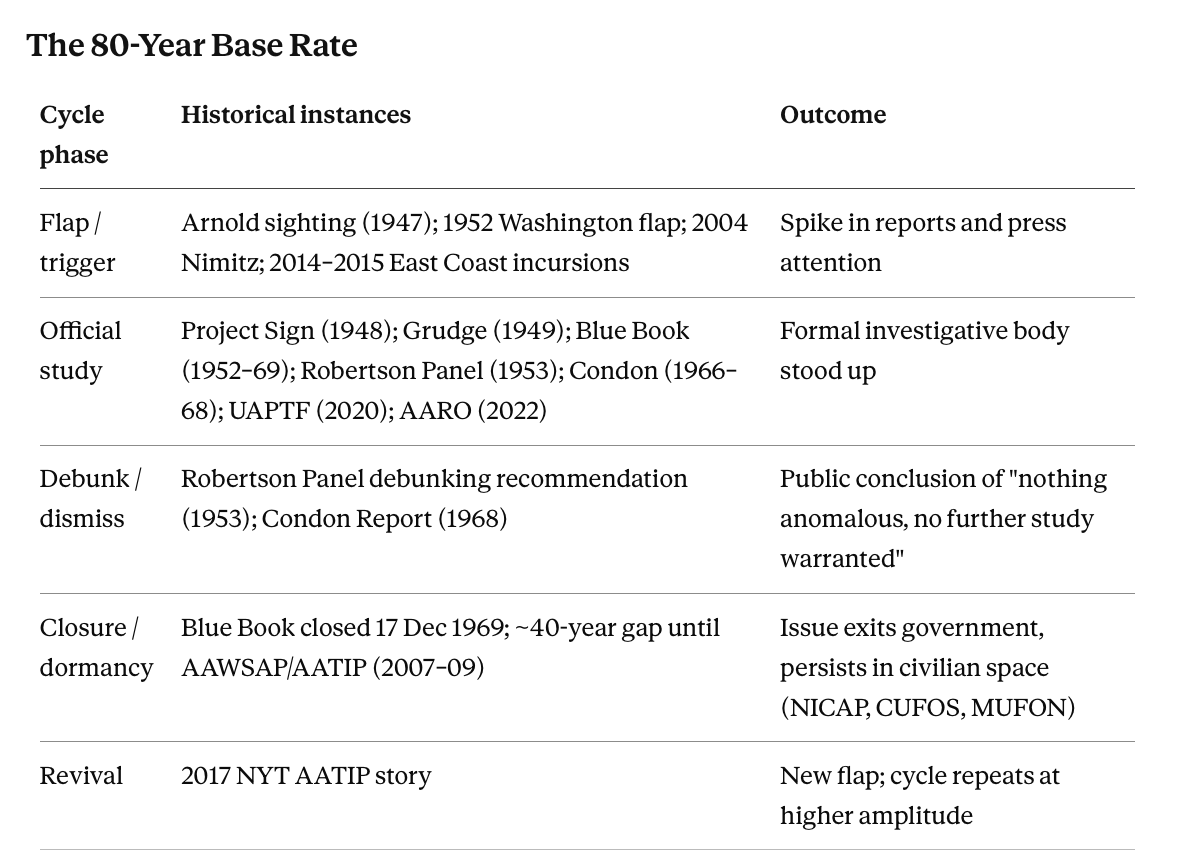
The base rate's quantitative core matters. Per the U.S. National Archives/USAF fact sheet, "From 1947 to 1969, a total of 12,618 sightings were reported to Project BLUE BOOK. Of these 701 remain 'Unidentified'" — roughly 6%. Condon found about one-third of its examined cases unexplained, yet still recommended termination — the precedent that "unresolved" has never compelled institutional persistence. The modern record echoes this. ODNI's June 25, 2021 "Preliminary Assessment: Unidentified Aerial Phenomena" examined 144 reports and stated: "We were able to identify one reported UAP with high confidence. In that case, we identified the object as a large, deflating balloon. The others remain unexplained" — but attributed the residue to poor data, not exotic origin. AARO's FY2024 Consolidated Annual Report (Nov 14, 2024) covered 757 reports and determined "21 cases merit further analysis," while stating that "to date, AARO has discovered no evidence of extraterrestrial beings, activity, or technology" — the "true anomalies" residue running near 3% after analysis. National ArchivesU.S. Navy History
The lesson we carry forward: official attention has a half-life. It has always decayed. "Unresolved case" percentages, however dramatic, have never by themselves prevented reversion to dormancy. Any forecast that this cycle breaks the pattern must identify the specific forcing function that prior cycles lacked. The current public framing illustrates the gap — the June 5, 2026 Kosloski-signed report released through PURSUE cites "40% of reported phenomena lack a reasonable explanation," a figure drawn from a constrained recent caseload that sits uneasily beside the ~3% "truly anomalous after analysis" the office reports elsewhere.
Probability Vocabulary
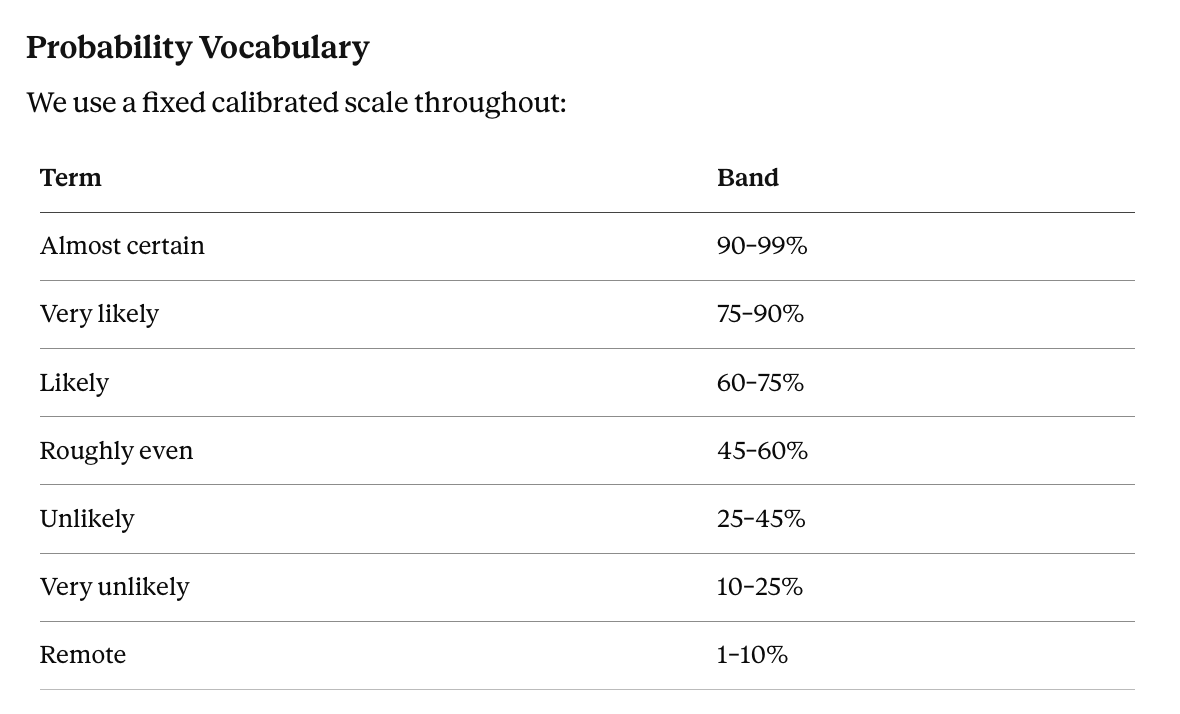
Claim tiers (applied where it matters): DOCUMENTED (primary record), DOCUMENTED-AS-REPORTED (credible reporting of a primary event), TESTIMONIAL (witness assertion), INFERRED (our analytic judgment), UNESTABLISHED (claimed but unverified).
Three Scenarios for the Disclosure Trajectory (2026–2036)
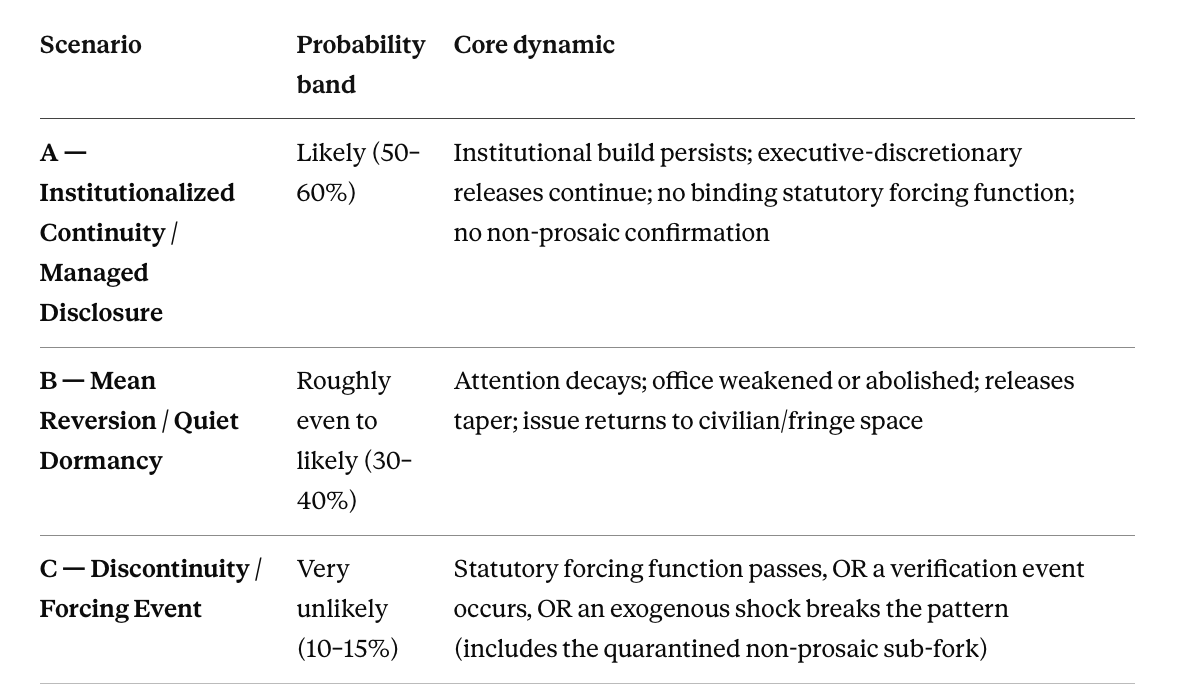
We hold these to sum to roughly 100%. The bands overlap deliberately to avoid false precision; our central estimate places A modestly ahead of B, with C as the low-probability tail.
Scenario A — Institutionalized Continuity / Managed Disclosure (Likely, 50–60%)
Narrative. The 2026 architecture persists in recognizable form. The Presidential Unsealing and Reporting System for UAP Encounters (PURSUE) — launched 8 May 2026 on war.gov/UFO and through three tranches by 12 June 2026 — continues rolling releases of largely low-context historical material; AARO survives in some form despite the abolition push; the new UAP Science Advisory Council (chaired by Harvard's Avi Loeb) and the interagency UAP Governance Board provide a veneer of scientific process; annual reports continue under existing NDAA mandates. Disclosure remains a managed, executive-controlled drip — high in volume (war.gov reported over 1.7 billion hits by mid-June 2026), low in evidentiary payload. As former AARO director Sean Kirkpatrick has cautioned, much of the released material reflects sensor artifacts and insufficient data rather than anomalous capability; Navy aviator Ryan Graves' verdict — "data alone is not disclosure" — captures the dynamic. No statutory eminent-domain or independent Review Board mechanism passes. GitHub
Signposts that confirm A: rolling PURSUE tranches continue past 2027 without a forcing statute; AARO survives H.R. 8197 or is rebranded rather than abolished; annual UAP reports continue; no UAP Records Review Board with subpoena power is enacted; "no evidence of non-human technology" remains the official finding.
Cross-sector implication: sustained but bounded attention. Episodic volatility around release events; no structural revaluation of any sector.
Scenario B — Mean Reversion / Quiet Dormancy (Roughly even to likely, 30–40%)
Narrative. The historical null reasserts. The 2028 or 2032 election turnover removes the executive champion; PURSUE — being discretionary, not statutory — is quietly discontinued; AARO is abolished or starved. The vehicle for abolition already exists: Rep. Tim Burchett's H.R. 8197 (introduced April 2026) would shutter AARO within 60 days, redistribute its functions across the services, and bar any centralized successor. The Science Advisory Council disbands or fades; congressional champions lose committee positions or retire. The issue migrates back to the civilian and commercial-media space — the documentary economy (Farah's The Age of Disclosure, Spielberg's Disclosure Day), podcasts, and private foundations — exactly as it did after 1969. Public interest, fed years of low-payload releases without a "smoking gun," fatigues. As Penn State historian Greg Eghigian observed, "disappointment can almost be guaranteed to be expected no matter what comes out of this."
Signposts that confirm B: PURSUE terminated or dormant after an administration change; AARO abolished with no successor; no new NDAA UAP mandates; congressional hearings cease; major disclosure figures exit government; declining media and search interest.
Cross-sector implication: attention-driven valuations deflate; the "UAP economy" (media, conferences, speculative ventures) contracts toward its pre-2017 baseline.
Scenario C — Discontinuity / Forcing Event (Very unlikely, 10–15%)
Narrative. The pattern breaks. One of three triggers fires: (1) a binding statutory forcing function — a revived Schumer-Rounds-style UAP Disclosure Act with an independent Review Board and eminent-domain authority — actually passes; (2) a verification event — a leaked authenticated primary document or material, or a validated scientific result; or (3) an exogenous shock — foreign-government disclosure or an adversary-capability revelation reframing UAP as a conventional strategic-surprise problem.
The statutory path has a documented track record of failure. The original Schumer-Rounds amendment — modeled on the 1992 JFK Records Act, with a presidentially appointed Review Board and federal eminent domain over "recovered technologies of unknown origin and biological evidence of non-human intelligence" — passed the Senate in 2023 but had its core provisions stripped in conference under intelligence-community pressure before enactment in the FY2024 NDAA. It was reintroduced as the "UAP Disclosure Act of 2025" (S.Amdt. 3111 to S. 2296, filed 29 July 2025) and again excluded from the final FY2026 law — the third consecutive year the full Act failed. Sen. Rounds has stated intent to "move forward once again," but no FY2027 version is confirmed as of 30 June 2026, and the FY2027 NDAA vehicle itself (H.R. 8800) contains no identified UAP records, disclosure, AARO, or Review Board provision in its chairman's mark or reported amendments. H.R. 8800 cleared committee (44-12) and the Rules Committee (8-4, 29 June 2026) but had not received a House floor vote as of this writing. The lesson: passing the announcement of disclosure is easy; passing a forcing mechanism with teeth has failed every time it has been tried.
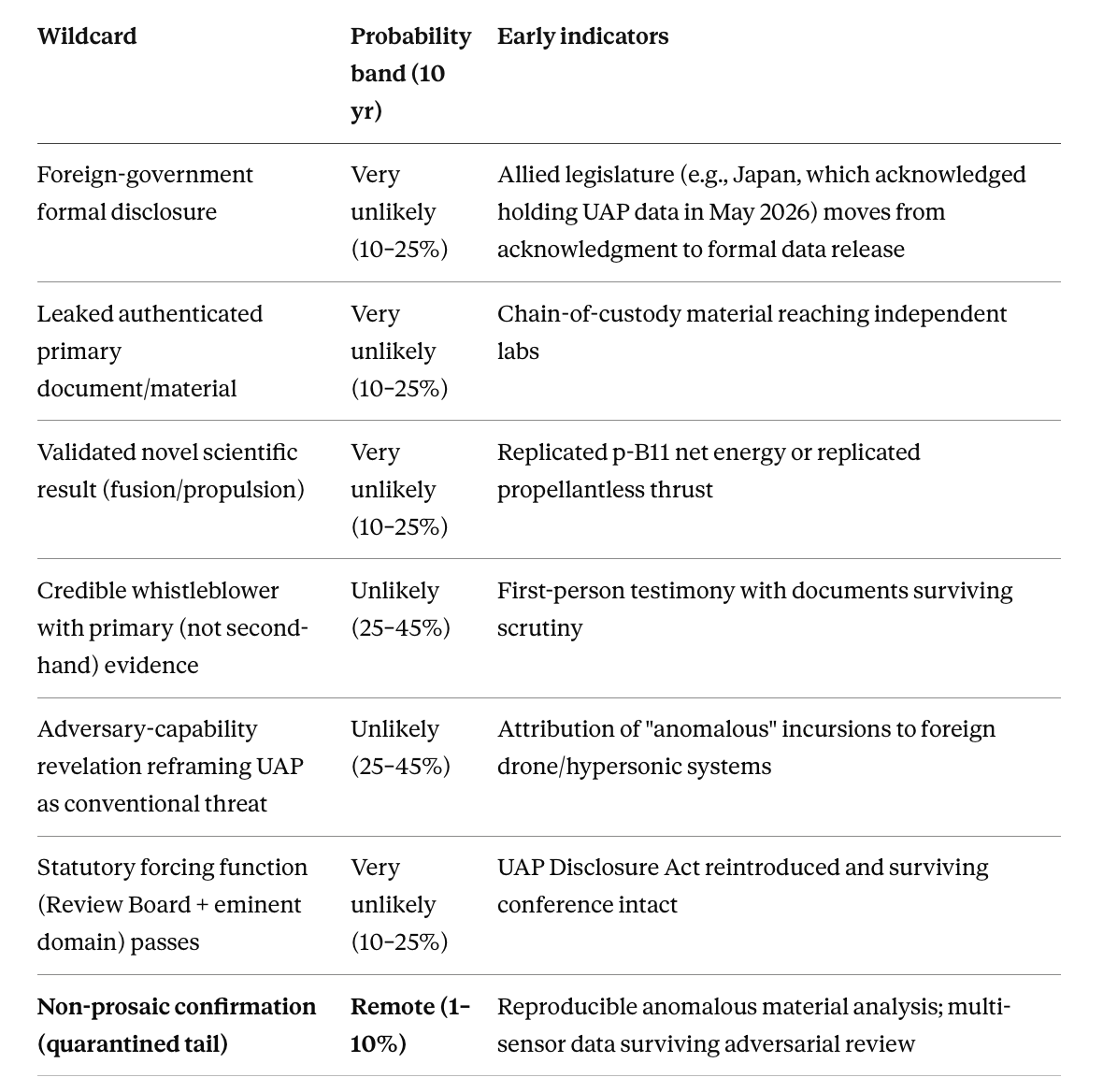
The quarantined non-prosaic sub-fork (remote, 1–10%): the most extreme tail within C is genuine confirmation of non-human intelligence or exotic technology. We label this clearly as the speculative branch. It is not assumed anywhere else in this forecast. Its early indicators would be: chain-of-custody physical material released to independent laboratories with reproducible anomalous isotopic or metallurgical findings; multi-sensor data surviving adversarial scientific review; or credible first-person (not second-hand) testimony accompanied by primary evidence. We note for discipline that the highest-profile testimonial claims to date — David Grusch's July 2023 sworn assertion of a "multi-decade UAP crash retrieval and reverse-engineering program" and recovered "non-human biologics" — remain TESTIMONIAL and second-hand (based on interviews with ~40 witnesses), and were assessed by AARO's 2024 historical review as resolving to misidentified authentic programs, with "no empirical evidence" of off-world technology. WikipediaNPR
Signposts that confirm C (prosaic forms): a UAP Disclosure Act with Review Board/eminent-domain passes both chambers; a G7 government formally confirms recovered non-human technology; authenticated primary material enters independent scientific custody.
Cross-sector implication: the only scenario producing genuine cross-sector revaluation. Magnitude depends entirely on which trigger fires; the non-prosaic sub-fork would be civilization-scale and is not modeled quantitatively here beyond the remote band.
Track 2 — Technical Convergence: 10-Year Read
We separate three questions the discourse routinely conflates: (1) Is integration happening? (2) Is any reference architecture uniquely predictive? (3) Does this bear on UAP origins? We answer the third in the negative and decline to let it contaminate the first two.
The null is continued isolation: well-funded fields advancing in parallel on shared physics (plasma, electromagnetism, superconductivity) without converging into a single coupled "exotic" architecture.
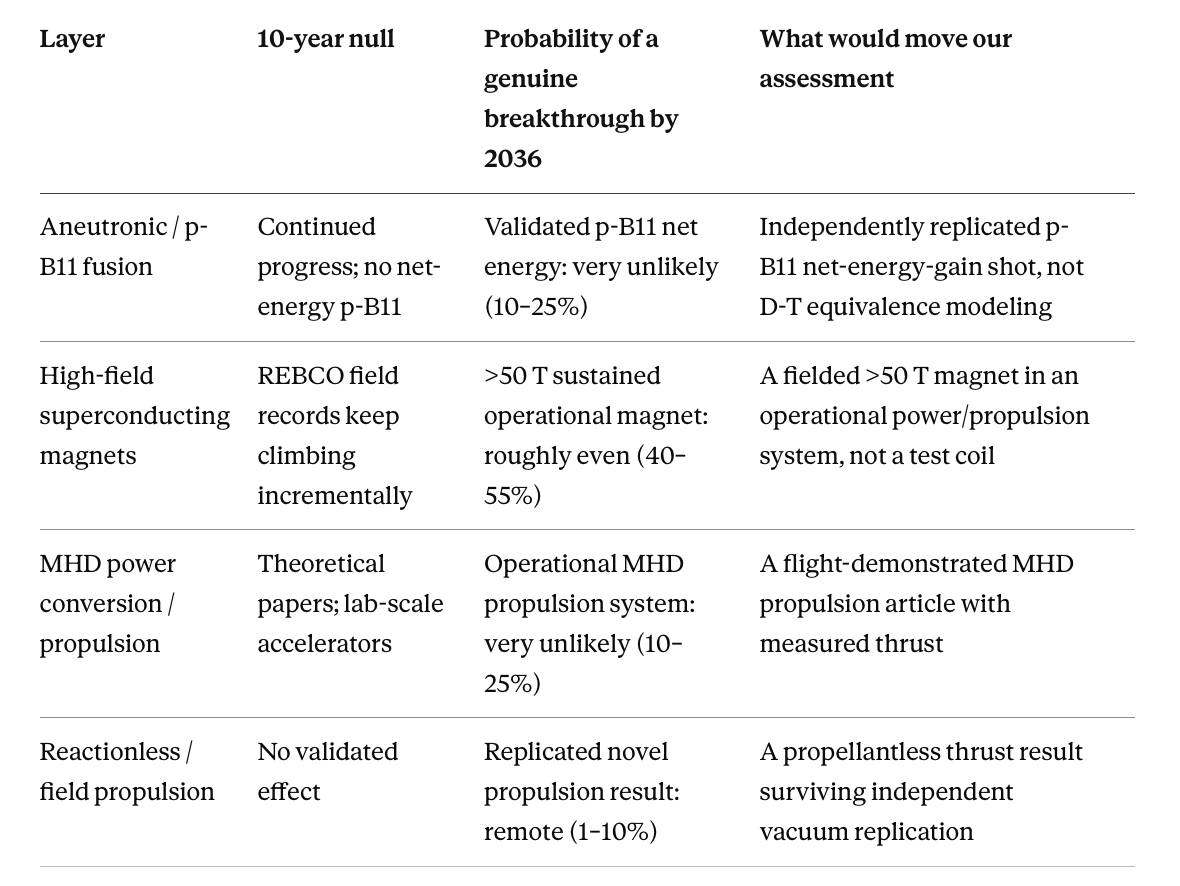
Layer detail. TAE Technologies announced (17 Nov 2025, results in Nature Communications) the first neutral-beam-injection-only formation of a field-reversed-configuration plasma in its "Norm" device — a genuine, well-capitalized milestone. Notably, TAE characterized this as obviating its planned next step: CEO Michl Binderbauer stated "Norm is such a tremendous breakthrough that it renders Copernicus unnecessary — saving us considerable time and cost." TAE's earlier p-B11 work with Japan's National Institute for Fusion Science produced the first such measurements in a magnetically confined plasma (R. M. Magee et al., "First measurements of p11B fusion in a magnetically confined plasma," Nature Communications, 2023, DOI 10.1038/s41467-023-36655-1) — real, but staged to D-T equivalence, not validated p-B11 net energy. The REBCO magnet frontier set a new world record in October 2025 with the FAMU-FSU/National MagLab "LBC9" coil; Chief Materials Scientist David Larbalestier noted it beat "the previous mark of 45.5 T by more than three tesla" at 48.7 T. MHD propulsion remains theoretical, with 2025 AIAA papers proposing architectures explicitly contingent on a "still-missing multi-megawatt compact fusion reactor." Reactionless propulsion remains refuted: TU Dresden's Martin Tajmar reported in March 2021 that "the cause of the 'thrust' was a thermal effect… Our measurements refute all EmDrive claims by at least 3 orders of magnitude," and subsequent claims (e.g., Exodus Propulsion) have not survived independent replication. WikipediaJpralves
The integration signal we would watch for: not parallel progress, but a single program coupling a compact aneutronic reactor to a high-field magnet system to drive an MHD or field-effect propulsion stage, with published, replicated performance. We assess the probability of such a coupled, validated architecture emerging by 2036 as very unlikely (10–25%), and we explicitly decline to treat even that as bearing on UAP origins. Common physics (plasma, magnets) is not evidence of common cause; isolation remains the disciplined default.
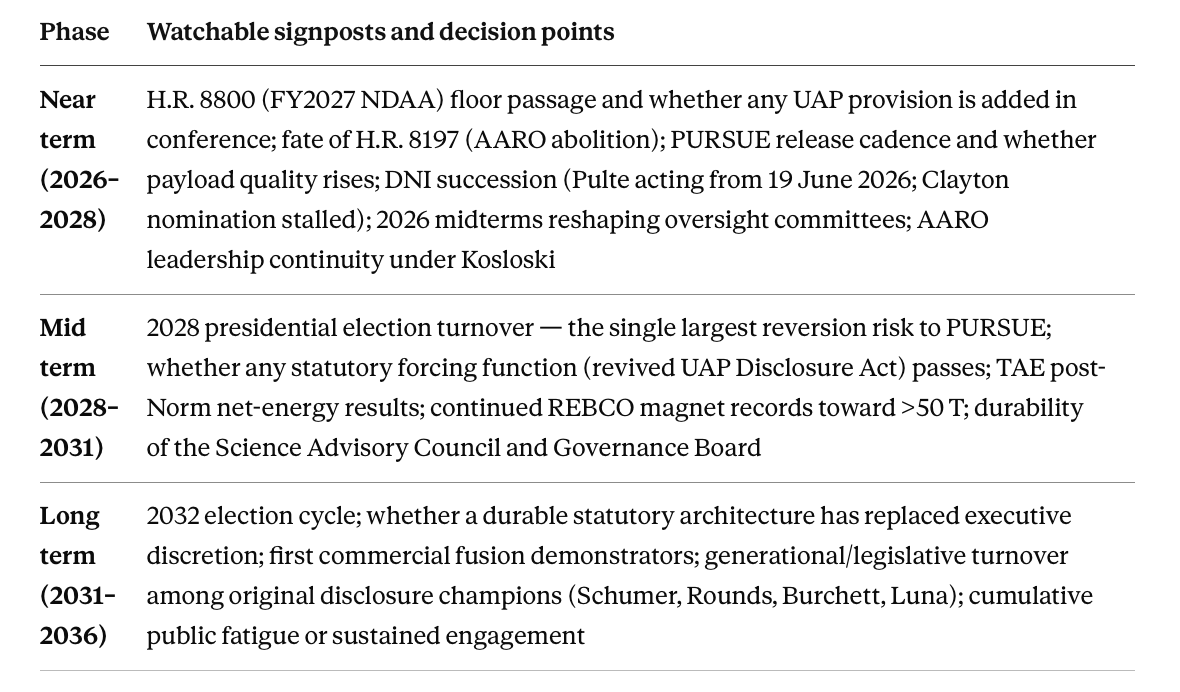
Phased Timeline
Wildcards / Tail Risks
Cross-Sector Risk Implications
Framed as assessed intelligence with stated confidence. This is not investment, legal, or financial advice. Predictive market calls default to low confidence.
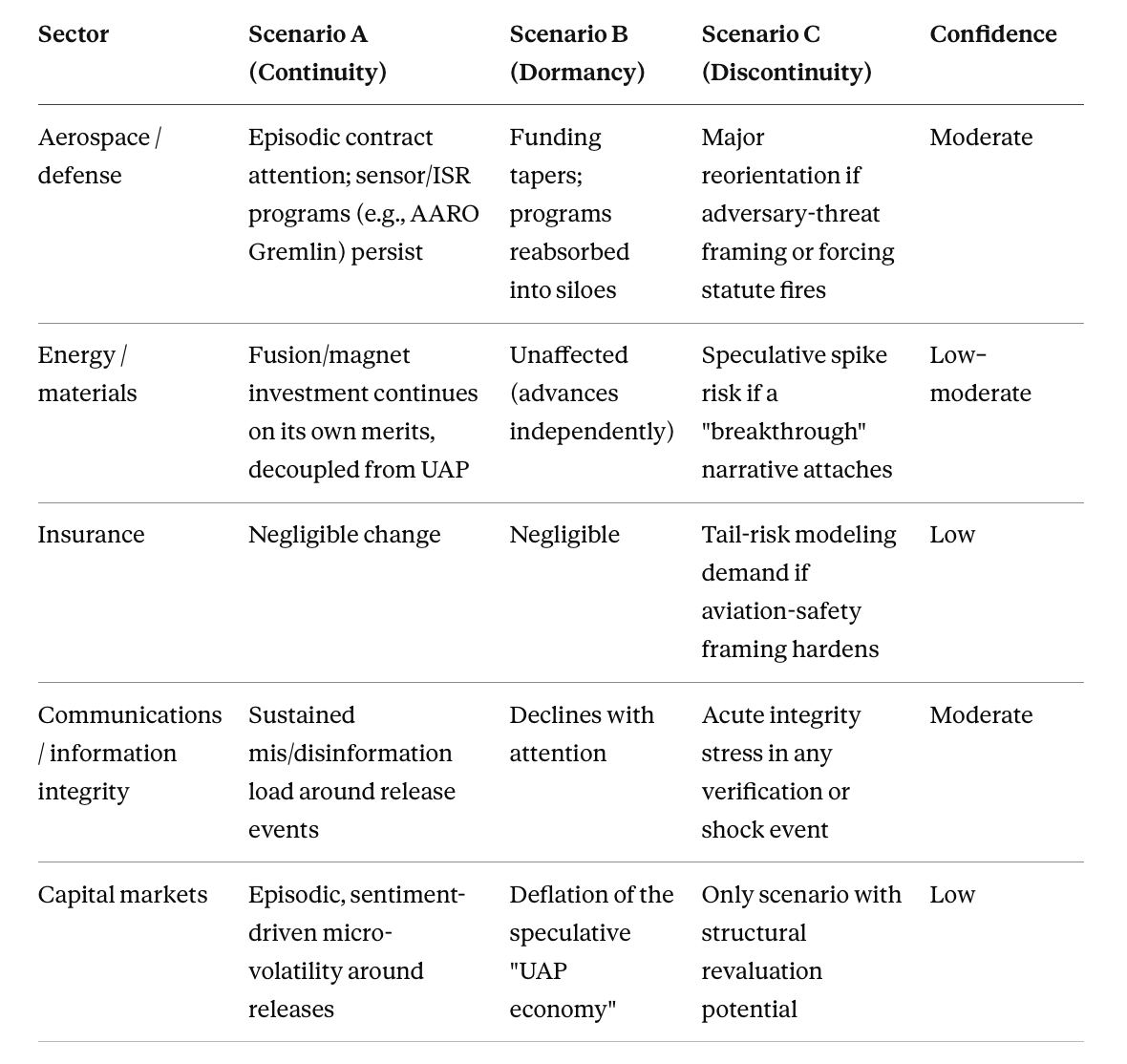
The dominant honest read: under the two most probable scenarios (A and B, together ~85–90%), there is no structural cross-sector revaluation. Energy and materials advances proceed on their own technical and commercial logic regardless of the UAP narrative, and we caution against conflating the two. We flag one specific contamination risk: the December 2025 reported merger linking TAE-adjacent fusion financing to politically salient media vehicles illustrates how a legitimate energy-technology story can acquire a speculative UAP-narrative premium that is not supported by the underlying physics.
What Would Change the Forecast
Toward regime change (would raise A/C, lower B):
A binding statutory forcing function passes (independent Review Board, eminent domain, hard declassification deadlines).
PURSUE survives a presidential transition intact and statutorily anchored.
Release payload quality rises from low-context historical material to high-context, analyzable multi-sensor data.
Allied governments move to coordinated formal disclosure.
Toward mean reversion (would raise B):
H.R. 8197 abolishes AARO with no successor.
PURSUE is discontinued after the 2028 or 2032 transition.
NDAA UAP mandates lapse; hearings cease; champions exit.
Public and media interest measurably decline.
Calibration Commitment
Every projection here is dated and falsifiable. We will grade this forecast against realized outcomes over time. We acknowledge the irreducible uncertainty of a 10-year horizon on a subject with this base rate: the error bars are wide, and the value of this document is the framework and the signposts, not false precision. We have argued up from the null, quarantined the non-prosaic branch, defaulted to organic explanations in the information environment, and declined to assert non-human origin as established anywhere. We hold that the burden of proof remains on "this time is different" — and that, as of June 2026, that burden has not been met. The institutional wave is genuine and deserves serious monitoring; it is not yet a regime change, and the historical record says the way to bet is that it will recede unless a forcing function we have not yet seen comes to pass.
