

Gene Sticco, Founder
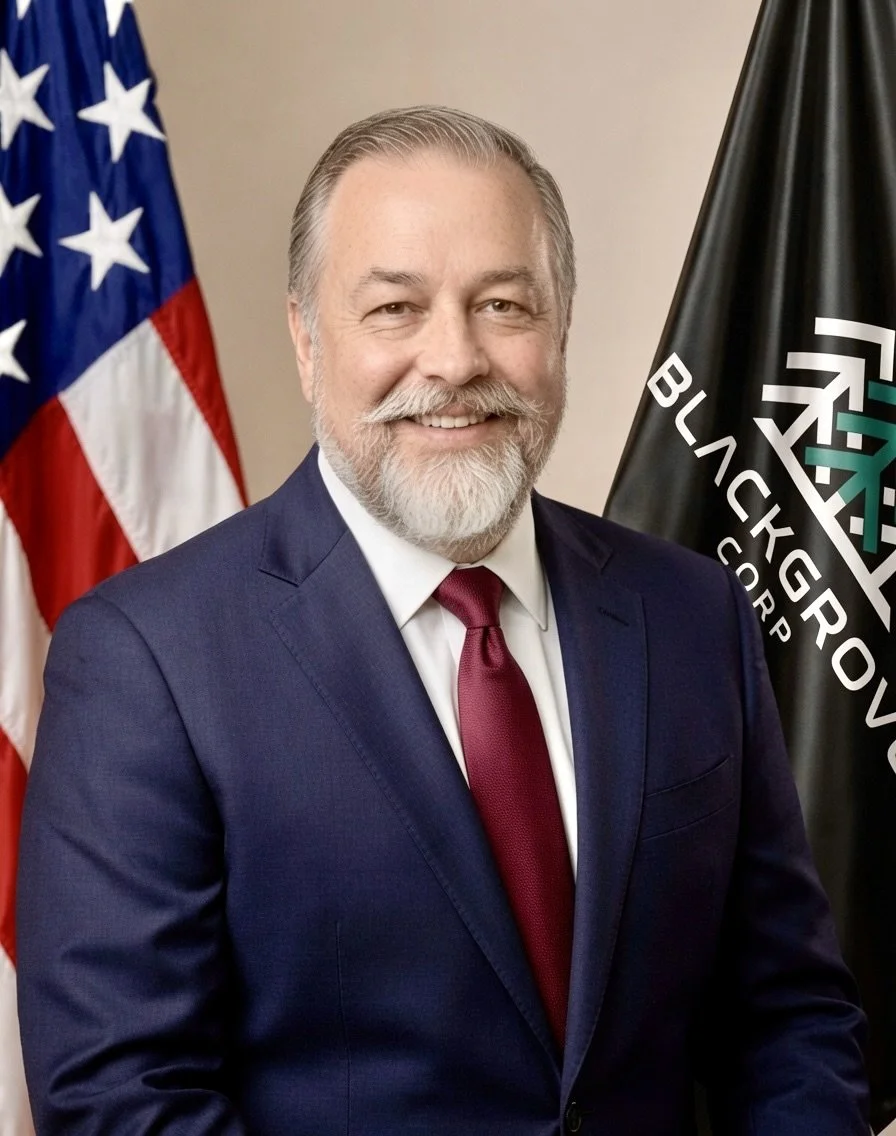
Before Gene Sticco built the first intelligence publisher dedicated to UAP risk, he spent over two decades doing exactly what Blackgrove does now — only for governments, energy supermajors, private military firms, and the interagency apparatus that holds the global security architecture together. The difference is that those clients already knew what the threat was. Blackgrove exists because the next one hasn’t been named yet — and Sticco may be the only operator in the field with the institutional credibility, intelligence tradecraft, and direct evidentiary access to name it properly.
His career began where the stakes are absolute. As a member of the U.S. Air Force Security Forces, Sticco was charged with the protection of nuclear weapons and strategic military assets — an assignment where analytical failure is measured in geopolitical catastrophe. That environment produced the core operating discipline that runs through every Blackgrove product today: systematic threat profiling, high-value vulnerability analysis, and the unsentimental habit of grading evidence before acting on it. He formalized that operational instinct at the Naval Postgraduate School, earning a Master of Arts in Security Studies with a concentration in Regional Security Studies — an academically rigorous program focused on geopolitics, foreign policy, and regional stability. It is the same graduate institution that trains flag officers, intelligence professionals, and senior defense officials, and the strategic analytical framework Sticco built there is embedded in every Blackgrove assessment published today.
From the nuclear perimeter, Sticco moved directly into the frontlines of post–Cold War energy security. He held Argentina in his security portfolio for Key Energy Services during a period of volatile South American exploration shifts, then was contracted into Williams Energy as the Director of Country Security for Lithuania. For two years he secured the Mažeikių Nafta complex — the largest oil refinery in the Baltic states — while Russian energy giants like Lukoil waged a multi-billion-dollar campaign for joint ownership and supply control. It was corporate warfare operating at state level: systemic sabotage, economic coercion, and geopolitical pressure converging on a single critical asset. Sticco designed and ran the physical and industrial security architecture for the refinery and its Būtingė marine terminal, shielding Western energy infrastructure from hostile state interests at the raw edge of the former Soviet sphere.
When September 11 restructured American aviation security overnight, Sticco was pulled stateside to manage the transition at Greater Rochester International Airport — one of a select few facilities permitted to retain private screening forces under a classified federal pilot program, the precursor to the Screening Partnership Program. He ran operations for a private screening company on the regulatory razor’s edge, implementing the TSA’s rapidly evolving security baselines within a private workforce under intense federal oversight. It was a masterclass in what happens when a government stands up an entirely new security paradigm in real time — experience that would prove directly relevant decades later, as another paradigm-level threat began its slow emergence into institutional view. His subsequent completion of the Naval Postgraduate School’s Critical Infrastructure Protection: Transportation Security program — where he scored in the top percentile — reflected a career-long discipline of mastering the formal analytical frameworks behind the operational decisions he was already making in the field.
That combination of international energy intelligence and domestic homeland security made Sticco the operator the interagency wanted at the table. From 2003 to 2005, he served as the U.S. Asset Protection Manager for Shell’s US refining, pipeline, and distribution network, driving the implementation of the Maritime Transportation Security Act across the company’s domestic infrastructure. It was during this period that the Department of Homeland Security contacted him to help architect its earliest Sector Coordinating Councils for the chemical and energy industries. Working directly alongside the Homeland Security Advanced Research Projects Agency, the CIA, and the FBI, Sticco operated at the founding center of post-9/11 interagency counterterrorism coordination — advising on field tests that used vapor-sniffing mass spectrometers to chemically fingerprint fuel signatures and trace terrorist supply chains, and mapping defense strategies for targeted physical assets before they could be exploited. The depth of his access was formalized in his designation as a Chemical-Terrorism Vulnerability Information Authorized User by the DHS Office of Infrastructure Protection — a vetted credential granting access to sensitive chemical terrorism intelligence reserved for individuals operating at the highest trust levels of the national security apparatus. He simultaneously completed the full FEMA certification architecture — the National Incident Management System, Incident Command System, National Response Framework, and Critical Infrastructure Security and Resilience coursework — credentialing himself across every layer of the domestic homeland security stack. The frameworks his work helped establish became structural to American critical infrastructure defense. This is the operating environment Blackgrove’s analytic standard was born from: interagency rigor, multi-source verification, and the discipline of grading intelligence before publishing it.
In 2006, Sticco’s career entered its most sensitive phase. He relocated to Shell’s corporate headquarters in The Hague, Netherlands, serving as the Global Security Manager for Gas & Power. Behind its administrative title, CAS functioned as Shell’s quiet intelligence wing: working hand-in-hand with friendly intelligence agencies while managing more hostile state-level surveillance threats, private security networks, and asset defense operations in high-risk zones worldwide. Sticco designed and implemented Shell’s first global security risk management methodology — a standardized analytical framework that brought unified structure to how the energy giant evaluated geopolitical risk across its entire international portfolio. His operational footprint spanned Iraq, Libya, Nigeria, Ukraine, Russia, the UAE, Qatar, Oman, Jordan, Kenya, Singapore, Australia, Bolivia, and Brazil. He enforced the International Ship and Port Facility Security Code across Shell’s global maritime operations and served on the committee that established the American National Standards Institute National Standard for Organizational Resilience — the blueprint modern enterprises still use to survive systemic disruption.
His work in conflict-affected regions demanded more than corporate security protocols. Sticco implemented the Voluntary Principles on Security and Human Rights on the ground in complex landscapes including the Niger Delta, ensuring that both private contractors and state security forces guarding Shell’s infrastructure operated within strict ethical frameworks. His engagement in this work was grounded not only in operational necessity but in formal training — including certifications from the United Nations Institute for Training and Research in Security Sector Reform, Unarmed Civilian Protection, and Conflict Analysis, as well as UN Advanced Security in the Field certification. The intersection of hard security and human rights compliance in contested zones is precisely the kind of multi-axis problem Blackgrove was designed to analyze.
Every one of those disciplines — global risk methodology, maritime security standardization, human rights compliance in conflict zones, organizational resilience architecture, and graduate-level strategic analysis — maps directly onto what Blackgrove publishes. The analytic standard, the sourcing tiers, the insistence on grading confidence before printing a judgment: none of it was invented for this company. It was field-tested across more than 120 countries and a dozen regulatory regimes before Blackgrove ever existed.
Sticco then carried that institutional intelligence background into the private military and high-risk advisory sector. As Vice President and General Manager of Olive Group North America, he commanded operational support and risk advisory frameworks for Western commercial operations in the world’s most dangerous theaters. At BHP Billiton, he managed security architecture for petroleum and extraction assets in Pakistan and Papua New Guinea — environments defined by tribal geopolitics, remote infrastructure vulnerability, and layered maritime logistics. As a Strategic Advisor to G4S, he provided intelligence-grade risk auditing and capacity building for global oil and gas clients facing asymmetric threats. These were not consulting engagements. They were operational deployments where the risk assessments had to be right because people and assets depended on them — the same standard Blackgrove applies to every published judgment.
Then Sticco did something that most career intelligence professionals never do: he testified against the system he had served. For years, multinational parent companies had used layered corporate structures to legally distance themselves from the actions of their foreign subsidiaries. Sticco stepped forward as a critical insider witness, providing detailed testimony that Shell and its CAS unit — the intelligence wing he had operated inside — exercised direct, top-down control over local subsidiary operations. His evidence served as a major catalyst in a landmark UK Supreme Court ruling establishing that multinational parent companies can be held directly liable for the actions of their overseas subsidiaries. The decision sent shockwaves through the global extractive industries and is still rewriting the rules of international corporate governance. That willingness to hold powerful institutions accountable — to prioritize structural truth over institutional loyalty — is not incidental to Blackgrove’s mission. It is the mission.
Today, Sticco’s memoir UNCONVENTIONAL: A True Story of Oil, Intelligence, and Consequence, draws on decades inside the intersection of corporate power, government intelligence, and global security operations.
But Blackgrove exists because of what came next. Following the death of his father-in-law in December 2019, Soviet-Latvian aerospace engineer Valerijs Černohajev, a cache of 119 handwritten manuscript pages — written in Russian between 1980 and 2007 — was transmitted to Sticco’s wife, Natalja Černohajeva-Sticco. Inside were twelve densely mathematical technical works: propulsion engineering blueprints, fusion reactor specifications, planetary magnetic field derivations, advanced materials parameters, and civilizational cycle analysis. The manuscripts bore every hallmark of a state-level research effort — a systematic, decades-long Soviet program aimed at the physics behind anomalous propulsion systems. In 2024, Sticco, as co-author and lead investigator, published Engineering Infinity: Earth’s First Interstellar Blueprint, the first translation of his father-in-law’s works, and established the Černohajev Archive & Research Institute to make the complete works to independent researchers and the public. Featured on NewsNation and other platforms, he approaches the material not through speculation but through the same structured analytic methodology he once applied to pipeline sabotage assessments, counterterrorism frameworks, and corporate espionage defenses — because at the operational level, the discipline is identical: evaluate the source, grade the evidence, test against the null, publish what survives.
That is what Blackgrove Global Risk does. It applies genuine intelligence tradecraft — built across nuclear security, graduate-level strategic studies, interagency counterterrorism, corporate intelligence operations, private military advisory, international standards architecture, and a historic act of institutional accountability — to the single largest unresolved variable in the global risk landscape. Sticco didn’t come to this subject from the outside. He arrived with the exact toolset it requires, the evidentiary access it demands, and the professional conviction that rigorous analysis matters more than comfortable silence.